
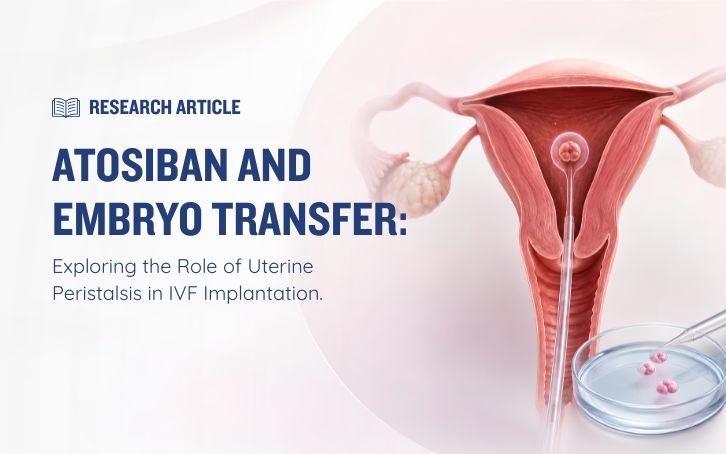
Atosiban and Embryo Transfer: Exploring the Role of Uterine Peristalsis in IVF Implantation
- ART / IVF Research
- 6–8 minutes
- Knowledge Centre
- BMJ Open
Introduction
Successful embryo implantation is a critical step in assisted reproductive technology (ART). Although advances in embryo culture, blastocyst transfer and cryopreservation have improved IVF treatment, implantation failure remains an important challenge in reproductive medicine.
One area of research is the relationship between uterine activity around the time of embryo transfer and implantation. The uterus is not completely static during the non-pregnant state. The myometrium exhibits rhythmic contractions, commonly referred to as uterine peristalsis. Research has suggested that abnormal or excessive uterine activity around embryo transfer may influence implantation outcomes.
Against this background, atosiban, an oxytocin receptor antagonist, has been investigated as a potential intervention around embryo transfer. The attached study by Cai et al. describes a randomised controlled trial designed to evaluate whether atosiban could improve outcomes in women with a previous single blastocyst implantation failure undergoing frozen-thawed blastocyst transfer.
What is the rationale behind atosiban in embryo transfer?
Oxytocin plays an important role in stimulating uterine contractions through its receptors in the myometrium. Atosiban acts as an oxytocin receptor antagonist, thereby providing a biological rationale for investigating whether reducing uterine contractility around embryo transfer could create a more favourable environment for implantation.
The study protocol discusses the hypothesis that atosiban may influence not only uterine contractility but potentially aspects of the endometrial environment, including blood flow and receptivity. These mechanisms, however, are presented as hypotheses and areas of investigation rather than established clinical outcomes.
Why is uterine peristalsis important in IVF?
Uterine peristalsis is a normal physiological phenomenon. During ART treatment, however, researchers have investigated whether the frequency and direction of uterine contractions around embryo transfer may be associated with implantation outcomes.
The study protocol cites previous research suggesting that uterine peristalsis during embryo transfer has been associated with reduced clinical pregnancy rates in both fresh and frozen-thawed embryo transfer cycles. It also discusses evidence linking abnormal uterine wave patterns with implantation failure and other adverse reproductive outcomes.
This provides the scientific basis for investigating whether pharmacological reduction of uterine activity could potentially influence embryo implantation.
What does the study investigate?
The paper, titled:
“Effectiveness of atosiban in women with previous single implantation failure undergoing frozen-thawed blastocyst transfer: study protocol for a randomised controlled trial”
was published in BMJ Open in 2023 by He Cai and colleagues.
The study focuses specifically on women undergoing frozen-thawed blastocyst transfer who have experienced one previous blastocyst implantation failure.
Conclusion
The investigation of uterine physiology during embryo transfer represents an important area of research in assisted reproduction. Atosiban has attracted interest because of its ability to antagonise oxytocin receptors and its potential influence on uterine contractility.
The study protocol by Cai et al. is particularly relevant because it proposes a large, placebo-controlled randomised trial focusing on women with previous single blastocyst implantation failure undergoing frozen-thawed blastocyst transfer. It also incorporates ultrasound assessment of uterine peristalsis, allowing researchers to explore whether treatment effects may vary according to uterine activity patterns.
However, current evidence remains inconclusive. Existing systematic reviews and clinical trials have produced mixed findings, and the available evidence does not establish that atosiban universally improves live birth or other IVF outcomes.
Further high-quality clinical research is therefore important to determine whether oxytocin antagonism has a meaningful role in selected ART populations.